The Solution Prep Workbook
The Iditol method for weighing, dissolving and diluting to the concentration on the label, the first time
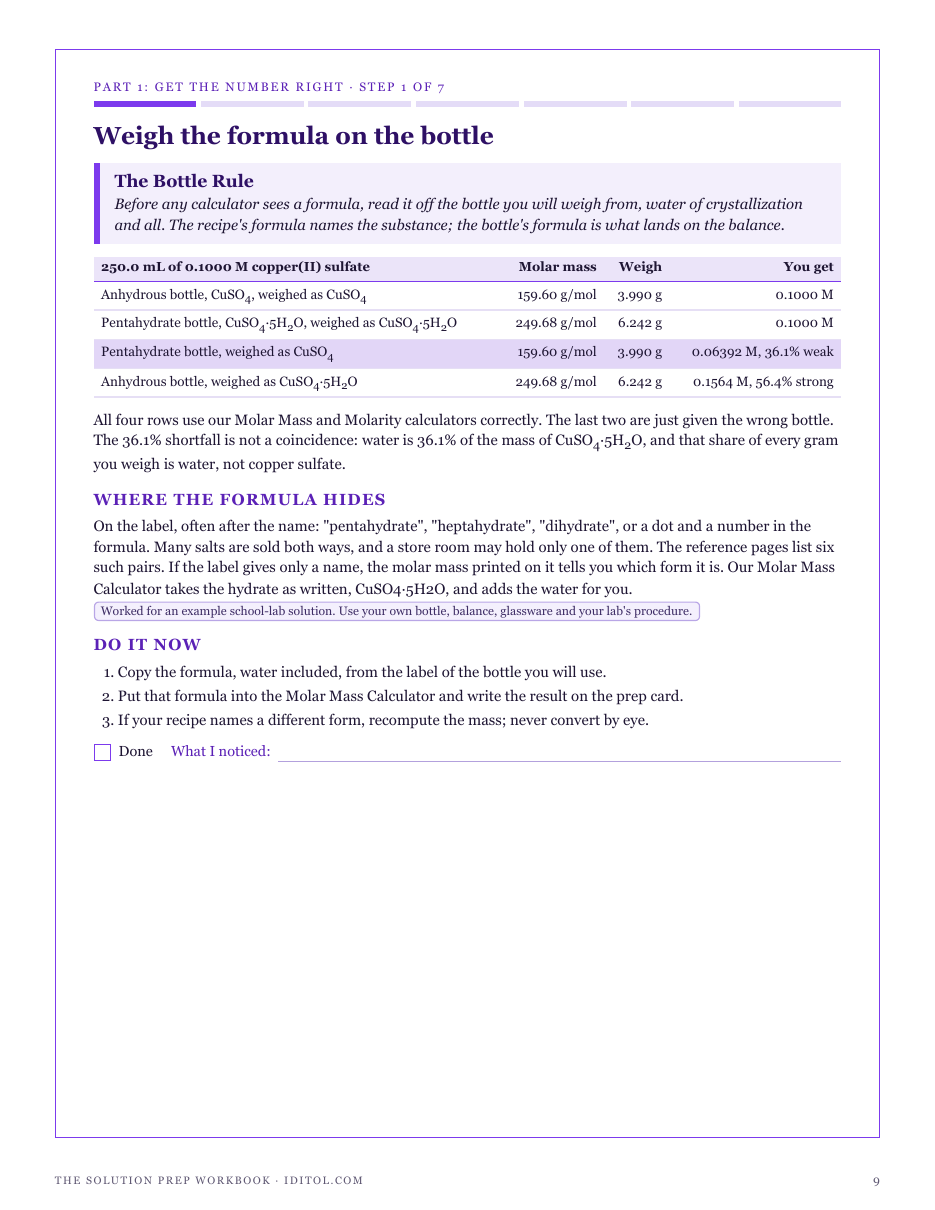
Our Molar Mass, Molarity and Dilution calculators each answer one question well, and never meet. None of them knows which bottle is on your bench, what your balance can weigh, how small a volume your pipette can deliver, or how many figures your answer deserves, and that is where solutions go wrong. The workbook joins them up. For 250.0 mL of 0.1000 M copper(II) sulfate the Molarity Calculator says 3.990 g of CuSO4; weighed out of a bottle of blue CuSO4·5H2O crystals, that makes 0.06392 M, 36.1% weak, because 36.1% of the crystal is water. It checks units with M x mL = mmol, rounds once to the figures you measured (6.24 g in 250.0 mL is 0.100 M, not 0.09997), shows when a mass is too small for your balance (0.02497 g is 40% uncertain on a 0.01 g balance) and plans the stock and serial dilution instead. The figures are examples with benign school reagents, computed by the site's own calculators; your bottle, balance and glassware replace them. A study and planning aid, not a lab procedure: follow your lab's SDS, procedures and supervisor, and add acid to water. Included: 23 printable pages with seven steps, three working pages, a hydrate and molar mass table and a quickstart, plus a personalised sheet worked from the numbers you entered in the calculator you came from.
Look inside
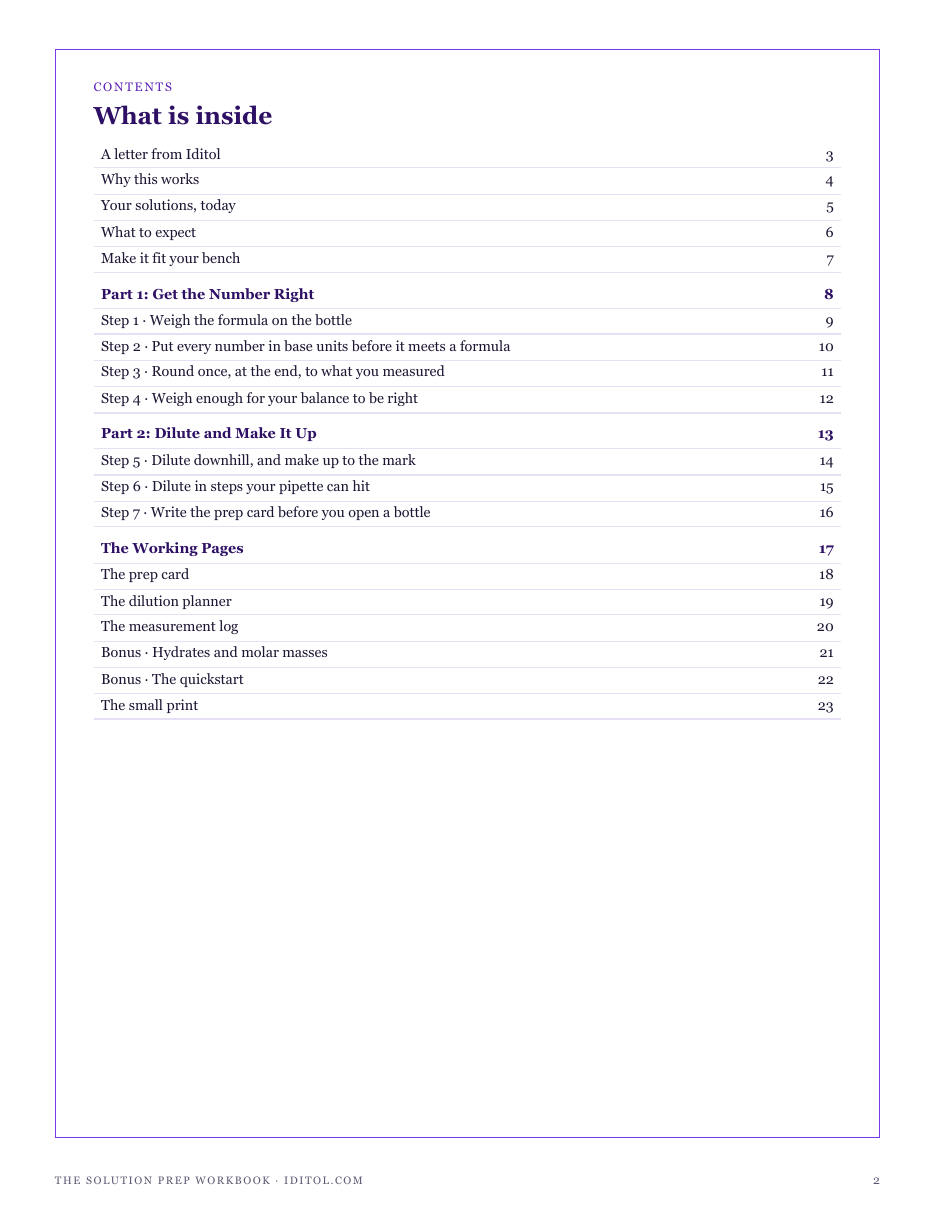
Two full pages from the workbook, exactly as printed. Click either to read it at full size before you decide.
What is in it
- The Bottle Rule: weigh the formula on the label, and what a hydrate does to a solution weighed as the anhydrous salt
- Base units before formulas, and the M x mL = mmol check that needs no conversion
- Significant figures: round once, at the end, to what you measured
- The Hundred-Times Rule: what your balance can really weigh, and when to make a stock instead
- Dilute downhill: the direction check, standards from a stock, and filling to the mark
- Serial dilutions your pipette can hit, with the error each transfer adds
- The prep card: planned and as-made columns, the label, and the SDS and waste lines
- A prep card, a dilution planner and a measurement log to print
- A table of six hydrate pairs and four plain salts, with grams for 100.0 mL of 0.1000 M
- A personalised sheet: your molar mass and hydrate check, the mass to weigh against your balance, and your dilution with its serial steps
- ✓ 23 printable pages
- ✓ 10 sections, worksheets and templates
- ✓ A second PDF worked out from the numbers you enter
- ✓ No account needed, just an email address
- ✓ Instant download; link valid 7 days
Price includes any taxes. Sold by GrabURL, who handle checkout and support. The charge appears on your statement as GrabURL.
The workbook picks up where the free Molarity Calculator leaves off. The calculator gives the mass for the formula you type; the workbook makes sure it is the formula on your bottle, water of crystallization included, checks the mass against what your balance can weigh, plans the dilution in steps your pipette can deliver with the Dilution Calculator, and shows how many figures the answer deserves. The worked figures are examples with benign school reagents; your own bottle, balance and glassware replace them. It is a study aid, not a lab procedure: follow your lab’s SDS, procedures and supervisor, and when diluting an acid, add acid to water.